






 Trap
 Normal
Fiend Comedian
View:
3984
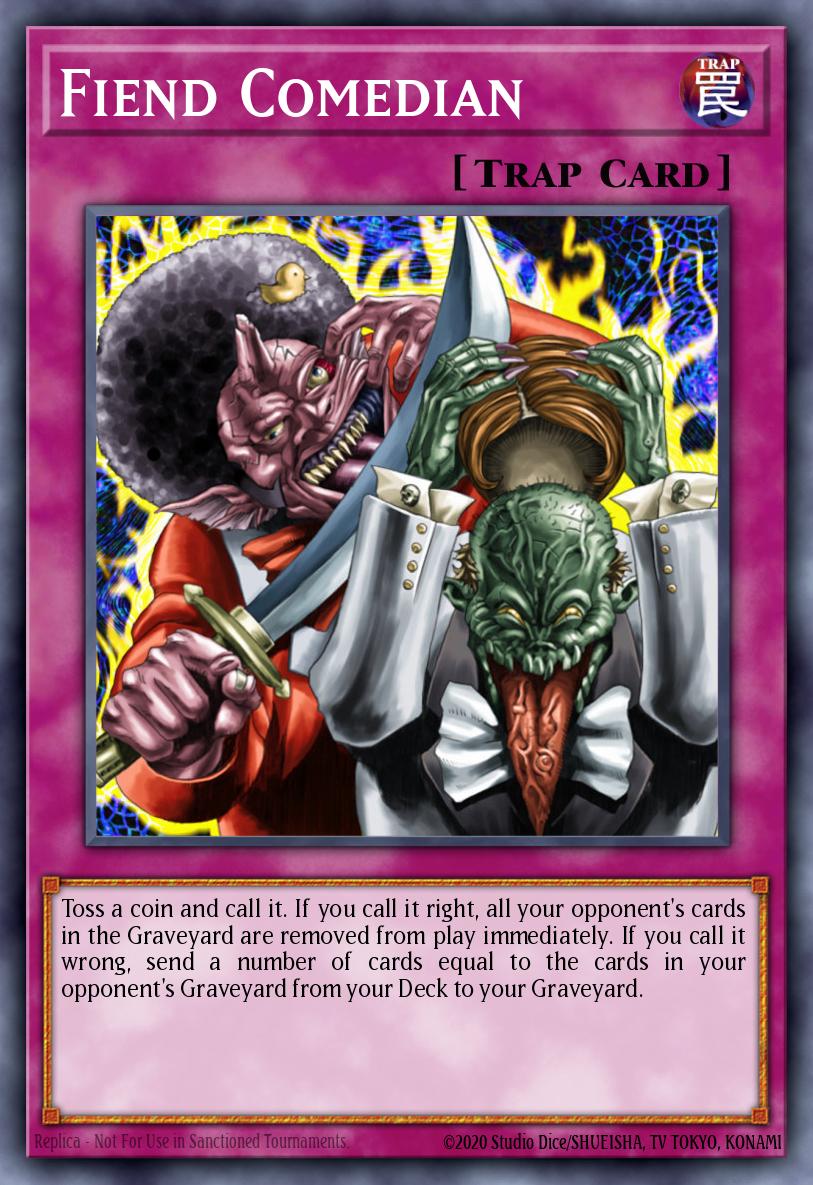
Toss a coin and call it. If you call it right, all your opponent's cards in the Graveyard are removed from play immediately. If you call it wrong, send a number of cards equal to the cards in your opponent's Graveyard from your Deck to your Graveyard.
Fiend Comedian — Power Evaluation
Final Score: 51 ± 8 · Confidence: Medium
- Intrinsic: 49 · Deck: 52 · Meta: provisional
- Primary role: Removal / Negation · Secondary: Utility
Why it scores here
Fiend Comedian is a graveyard-hate trap whose value depends on a coin call: a correct call removes the opponent's graveyard, and a wrong call mills the same number of cards from the user's own deck. Its score comes from being a live, cheap trap that 114 recorded decks run across 37 archetypes, most often alongside Transaction Rollback and Trap Trick. The card has no recorded combo evidence and cannot be material, so its high deck count confirms that it is a practical staple, not that it is strong. Its high stats count for nothing here; the 50% self-mill downside caps resource economy.
Axis scores
| Axis | Score | Evidence |
|---|---|---|
| Accessibility | 55 | Set-trap access with 114 decks and 1.62 average copies, but no searcher or hand route in the evidence (observed). |
| Combo & Conversion | 15 | No combo boards recorded; its effect only strips the opponent's graveyard or mills the user, with no board built (verified from text). |
| Resource Economy | 40 | Half the time the wrong call mills the user's own deck by the opponent's graveyard size, a real cost; the correct call gives only minor graveyard disruption (verified from text). |
| Effect & Interaction | 40 | Graveyard removal is situational and coin-dependent, and it does not stop board plays (verified from text, inferred for strength). |
| Material Utility | 5 | A trap card cannot be used as material, so the body contributes nothing here (verified from text). |
| Resilience & Flexibility | 40 | A set trap can be negated like any trap, and the 50% call makes its effect unreliable across turns (inferred). |
| Deck-Building Efficiency | 80 | A single-copy-friendly trap with no garnet or lock restriction, and 61% of decks run it at 1–2 copies (observed). |
Calculation
Weight profile: Removal / Negation, single primary role, no secondary blend. Intrinsic ≈ 49, Deck ≈ 52, Meta = provisional. Modifiers: none. Final formula: 0.40*Intrinsic + 0.60*Deck
Strengths
- Cheap, live trap present in 114 recorded decks across 37 archetypes
- Graveyard hate is relevant against graveyard-recursion decks
- Easy to run: low copy count and no garnet or lock cost
Weaknesses
- Coin-call outcome is a 50% gamble, and the wrong call mills the user's own deck
- No combo evidence; it does not build a board or advance a combo
- Cannot be used as material; its effect is only situational graveyard disruption
Counters / choke points
- Negation of the trap while it is set
- Decks that keep their graveyard empty or do not rely on graveyard resources
Best use
Situational graveyard-removal trap. Decks: Trap-based decks running Transaction Rollback and Trap Trick, Graveyard-reliant opponents in Paleozoic, Eldlich and Lightsworn lists. Suggested copies: 1.
Evidence & gaps
- Verified: Coin-call effect text: correct call removes opponent's graveyard; wrong call mills an equal number from own deck; Trap card type; cannot be material
- Observed: 114 decks, 61.4% gameplay 4, 35.1% gameplay 7, 37 distinct archetypes; Average 1.62 copies per deck; 61 decks run 1 copy
- Inferred: Set-trap access is the main route; no searcher or hand route is in the evidence; Negation by a trap-negating card is the main counter
- Data gaps: no combos supplied — combo conversion is text-only inference no guides supplied no banlist token — assumed 3 copies (unlimited) usage statistics has a single archetype row (Guardragon 100%), too sparse to calibrate inclusion